Revolutionary Relic
William Pitt's South Carolina Sojourn

In the Charleston County Judicial Center in South Carolina, a relic of the American Revolution is hiding in plain sight. Few visitors to the modern courthouse on Broad Street likely know anything about the statue of the toga-robed man carved in Italian marble. Nor do they realize that British Americans erected it in 1770 as a monument to celebrate the triumph of British liberty and constitutional government over the forces tyranny and Parliament’s aggressive attempts to tax the colonies.
To see it, I persuaded my family to indulge me during a recent trip to the South Carolina Aquarium in Charleston. After admiring Moon Jellyfish, petting sting rays, and watching the resident loggerhead turtle named “Caretta” swim gracefully through the aquarium’s largest tank, the family dropped me off on Broad Street and began circling the block, leaving me with just enough time to head inside the courthouse to see the statue of William Pitt.
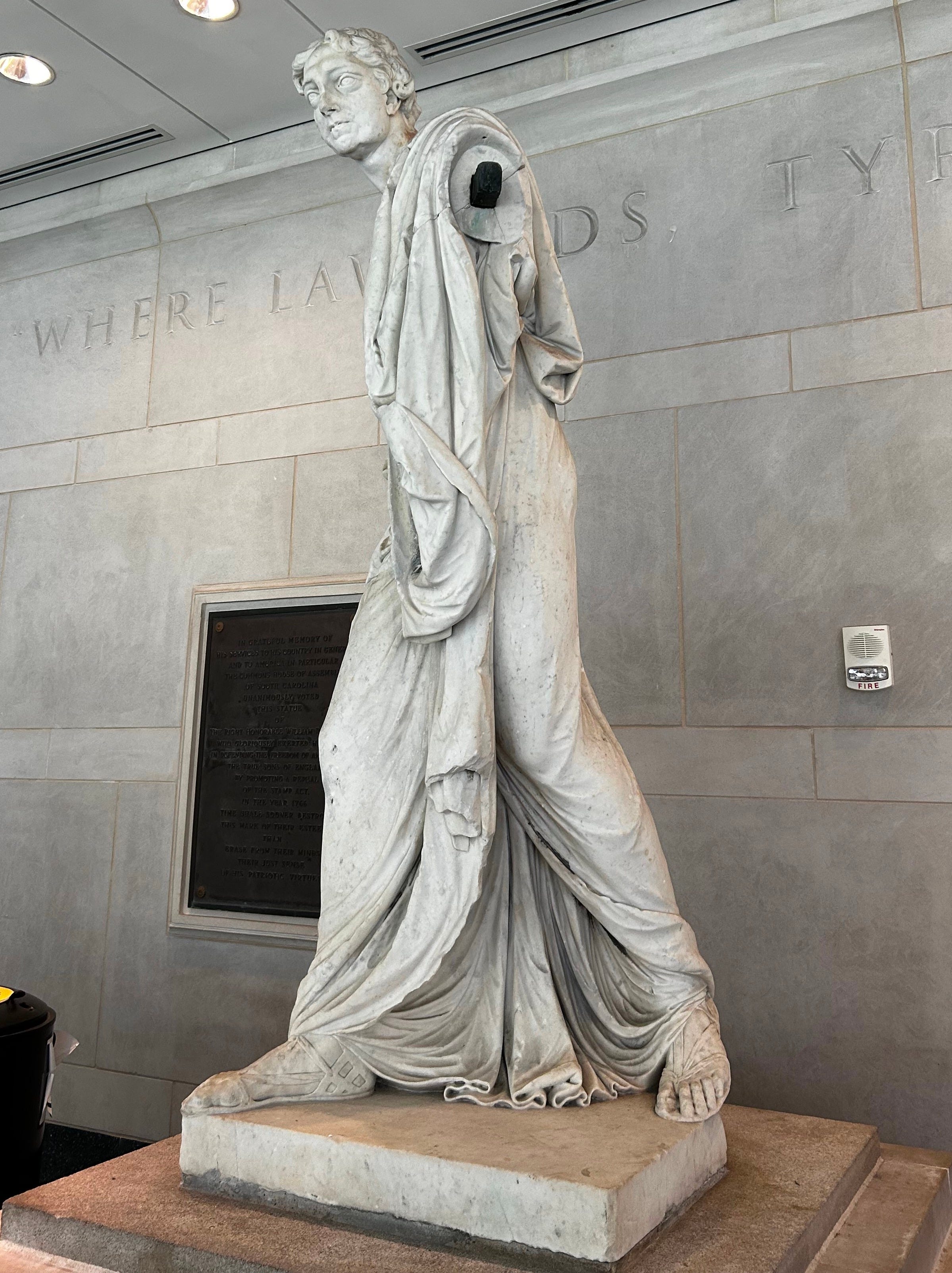
“That great Assertor of American Liberties,” as the Trustees of Harvard College once called him, stands silently in the courthouse lobby. After passing through security and confirming with a bemused police officer that I would be allowed to take pictures of the marbled man, I doubled back toward the exit, where Pitt was waiting for me.
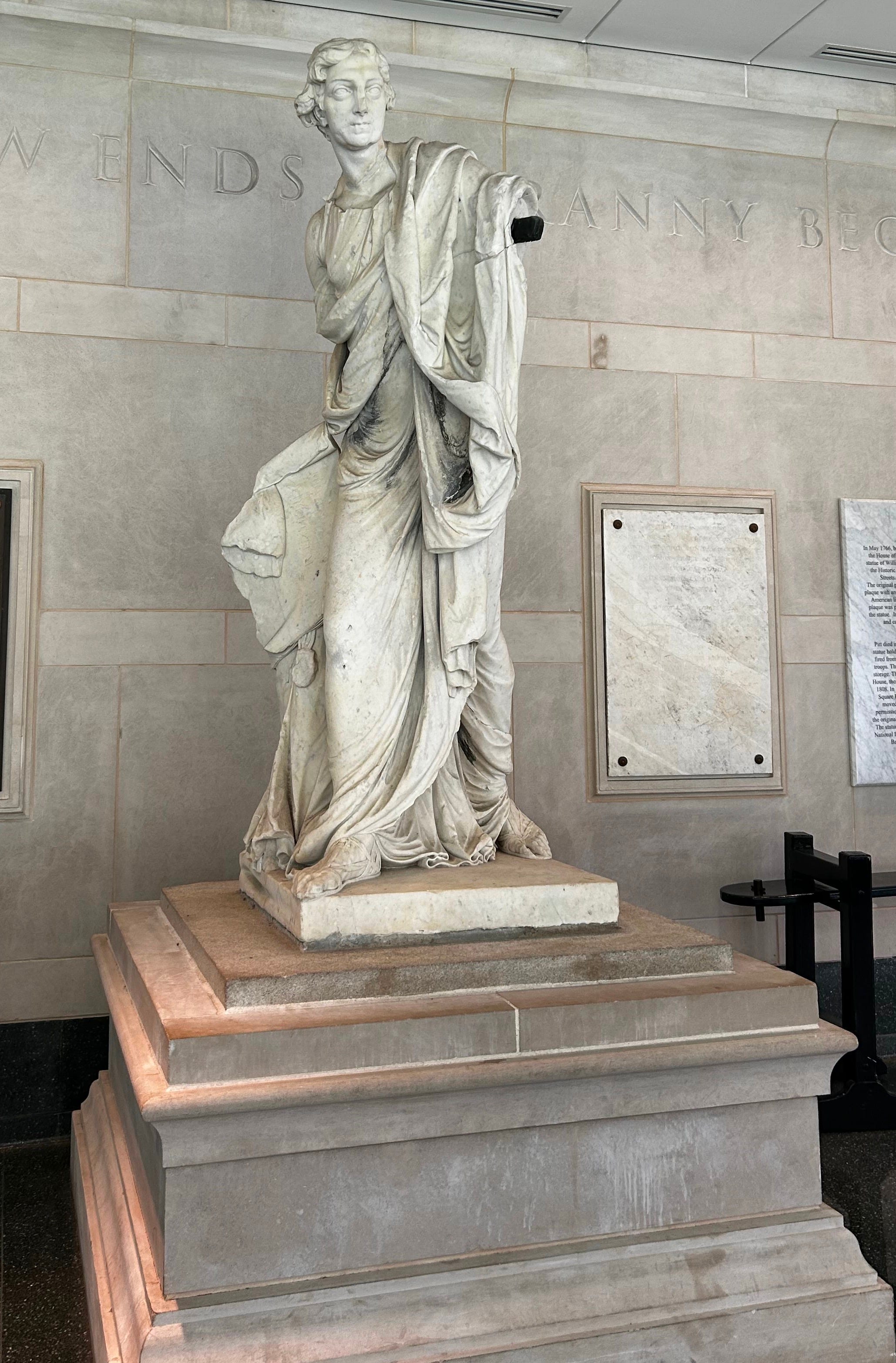
But how did Pitt’s statue get there? And who commissioned it in the first place? To answer these questions, we must go back more than a decade before Americans declared independence when, in the aftermath of a global war, colonists were never more proud to be British, and Parliament struggled to account for the war’s costs.
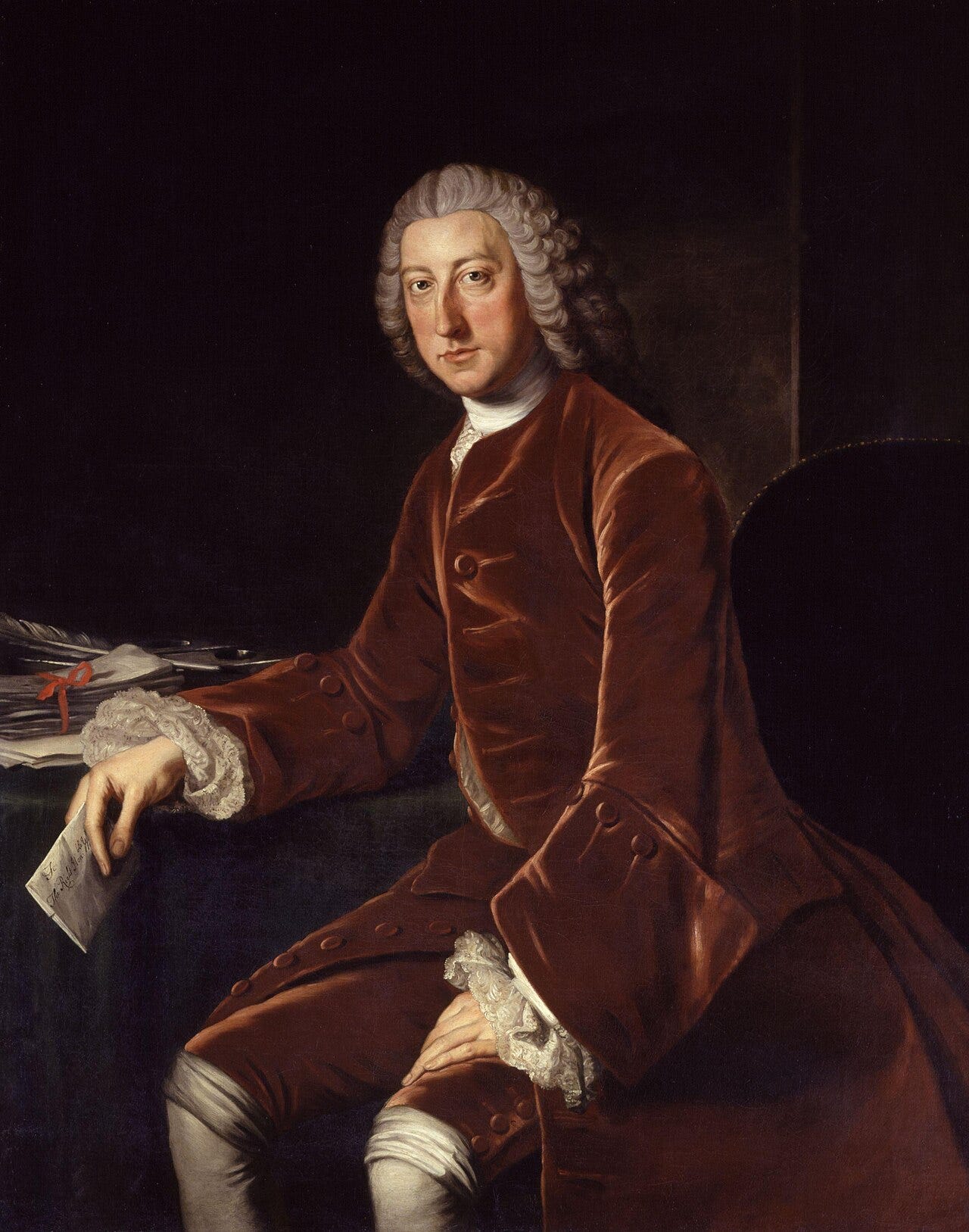
Pitt first endeared himself to British Americans in the late 1750s. Although he wasn’t prime minister at this point in his career, he might as well have been. In 1757, Pitt became Leader of the House of Commons. As a member of the House of Lords, the Duke of Newcastle, then the prime minister, could not manage the government’s business in the Commons. That task fell to Pitt, who was also appointed Secretary of State for the Southern Department that same year. As secretary, Pitt had oversight of the American colonies in coordination with the Board of Trade.
Pitt assumed office as a perilous moment. Three years earlier, a skirmish in the Pennsylvania woods between Virginia troops and French Canadian soldiers soon sparked the Seven Years’ War. The conflict pitted Britain, France, their respective colonies and Indigenous allies in North America, and their allies in Europe and India, in a battle for the control of land, sovereignty, and imperial supremacy.
At first, the war went very badly for the British.
British military officials ignored provincial advice on how to fight in the American woods. British commanders-in-chief clashed with colonial assemblies over troop recruitment and the taxes needed to support them. Colonial officers bristled at the fact that provincial officers holding the same rank as officers in the regular army were made junior to their British counterparts. A colony’s unwillingness to send soldiers beyond its borders befuddled British commanders, who could not understand why people who professed to be British would not do everything they could to defend the king’s interest. These problems and more plagued the British war effort. By 1757, France — with its much smaller colonial population and stronger relationships with Native peoples — stood on the brink of victory.
Pitt’s ascendency helped to turn the tide of the war in Britain’s favor. He began borrowing significant sums of money on the government’s behalf to finance the war effort, conducted aggressive diplomacy in Europe, and resolved many of the sticking points — like questions of rank and taxation — that had hindered early cooperation between the British military and colonial governments. Together with the Haudenosaunee’s willingness to break their neutrality in the conflict and side with the British, Pitt’s efforts helped to secure a British victory in North America by 1760 and globally by 1763.
American colonists lionized Pitt for his willingness to treat them properly as the British subjects they were as well as equal partners in empire.
But the cost of Britain’s victory had been great due in no small measure to Pitt’s financial wizardry. In the early 1760s, a new government led by George Grenville began pursuing measures to alleviate a national debt that had ballooned to over £130 million, govern and defend newly conquered colonies like Quebec, Grenada, and East and West Florida, and negotiate new agreements with Native peoples in the west.
Grenville and other ministers like him believed that the colonies ought to start bearing some of the costs associated with running the empire. After all, the British had won a once unimaginable victory from which the colonists would only benefit. Catholic France had been defeated in North America, new lands were available for cultivation, and colonists now lived in a much grander empire of liberty. For Grenville, the solution to part of this problem was simple: a stamp tax.
Britons at home had long been accustomed to paying stamp duties on legal documents, newspapers, and all manner of goods. Grenville saw no reason why colonists shouldn’t pay them as well. He believed that a stamp duty in the colonies would be the most effective means of paying for the British regulars who would be stationed in the backcountry to help keep the peace between settlers and Native peoples. But more than that, it would demonstrate that Parliament possessed the power and had the right to levy such a tax on British Americans.
For more than a century, colonists had paid customs duties on trade goods (or avoided them through smuggling), but did not pay what they would soon call “internal” or “direct” taxes. In their view, only their local assemblies had the constitutional authority to levy direct taxes on them.
Grenville thought otherwise. In his mind, Parliament was the supreme legislature of the empire. Most Britons shared this view. One would struggle and fail to find a Member of Parliament who thought differently. This belief was not without good reason. In the seventeenth century, monarchs such as Charles I and his successors had tried to rule without Parliament, using income from other sources to fund their ambitions and consolidate their power. A series of civil wars, an interregnum, and a “Glorious” Revolution later, Parliament forced the creation of a constitutional monarchy when it invited William and Mary to take the throne in 1689 after James II’s abdication. Parliament would now rule alongside the monarch.
The Revolution and its aftershocks were still within living memory in Britain. Men like Grenville were under no illusions that a future monarch might not try to assert their independence from Parliament and once again rule without it by drawing on crown revenue from the colonies. Asserting Parliament’s supremacy over British America was but one means to secure the revolutionary settlement and manage the empire. That meant — as Grenville and others believed — that Parliament possessed the constitutional authority to lawfully tax the king’s subjects wherever they were, regardless of whether or not they had representation in Westminster.
Notwithstanding his concerns, Grenville did not help himself or his constitutional case for colonial taxation when he announced in Parliament in March 1764 that his government was considering a stamp duty. No specifics, only that a tax was likely. He doubled down on that vagueness by telling colonial agents (lobbyists) in London that colonists might avoid direct taxation if their home governments levied the tax themselves, but he would not tell them the proportion each colony owed until they acknowledged Parliament’s supremacy. That sharp stick dangled a bitter carrot that was hard for colonists to swallow.
Grenville’s announcement and Parliament’s passage of the Stamp Act in 1765 set off repeated waves of protests and violence in the colonies. With the law set to take effect on November 1st, they attacked crown-appointed stamp distributors and intimidated them into resigning, burnt Grenville and the devil in effigy, destroyed property, shuttered the courts, and wrote numerous pamphlets, letters, and petitions decrying the Stamp Act as “taxation without representation.” Even then, it took a loosely enforced trade boycott and pressure from British merchants to convince Parliament to back down.
Pitt played a key role in the Stamp Act’s repeal. Like Grenville, Pitt had no doubt about Parliament’s supremacy. Where they differed was in the wisdom of using Parliament’s authority, even if all acknowledged that the legislature possessed it. As he argued in the House of Commons in early 1766:
Upon the whole, I will beg leave to tell the House what is really my opinion. It is, that the Stamp Act be repealed absolutely, totally, and immediately; that the reason for the repeal should be assigned, because it was founded on an erroneous principle. At the same time, let the sovereign authority of this country over the colonies be asserted in as strong terms as can be devised, and be made to extend every point of legislation whatsoever: that we may bind their trade, confine their manufactures, and exercise every power whatsoever — except that of taking money out of their pockets without their consent.
Pitt carefully threaded a delicate needle by at once asserting Britain’s sovereignty and Parliament’s authority over the colonies, and its power in “every point of legislation whatsoever,” while claiming it shouldn’t exercise those powers in every respect. Pitt confidently declared that “Americans were the sons not the bastards of England,” and entitled to the right of being taxed with their consent, without ever denying Parliament’s own power.
The theatricality of Pitt’s performance also made for awkward family drama. When he rose to argue for the Stamp Act’s repeal, Grenville stepped forward to defend it.
The two men were brother-in-laws.
When British Americans learned of the hated tax’s demise in the spring of 1766, jubilant colonists rang church bells, offered toasts to Pitt and King George III, and praised the British constitution as the finest on earth. They ignored Pitt’s oratorical sleight of hand and largely pretended not to notice the concurrent passage of the Declaratory Act, which reaffirmed Parliament’s right to legislate for the colonies “in all cases whatsoever.” The crisis was over; the constitution had held.
In South Carolina and New York, talk turned to how colonists might best express their gratitude to Pitt for his defense of British American rights and liberties. The assemblies in both colonies quickly decided that statues would be a fitting tribute.
On May 8, 1766, South Carolina’s House of Commons voted to appropriate money to procure “from England, a Marble Statue of the Right Honourable William Pitt, Esquire; to be erected in this Province.”
New York soon followed suit. New Yorkers also ordered a gilded equestrian statue of King George III, feeling that it would be appropriate to honor the monarch for his role in signing the Stamp Act’s repeal. (For the story of that statue and its grisly destruction, stay tuned to ForgingUs for my forthcoming digital exhibit on “His Melted Majesty” or check out this Smithsonian article by leading expert Dr. Wendy Bellion).
Both New York and South Carolina commissioned English sculptor Joseph Wilton to execute the statues of Pitt. By the late 1760s, Wilton was well-known for his marble work. Trained in the Neo-classical style, he studied on the Continent, learning his craft in Italy, France, and what is now Belgium.
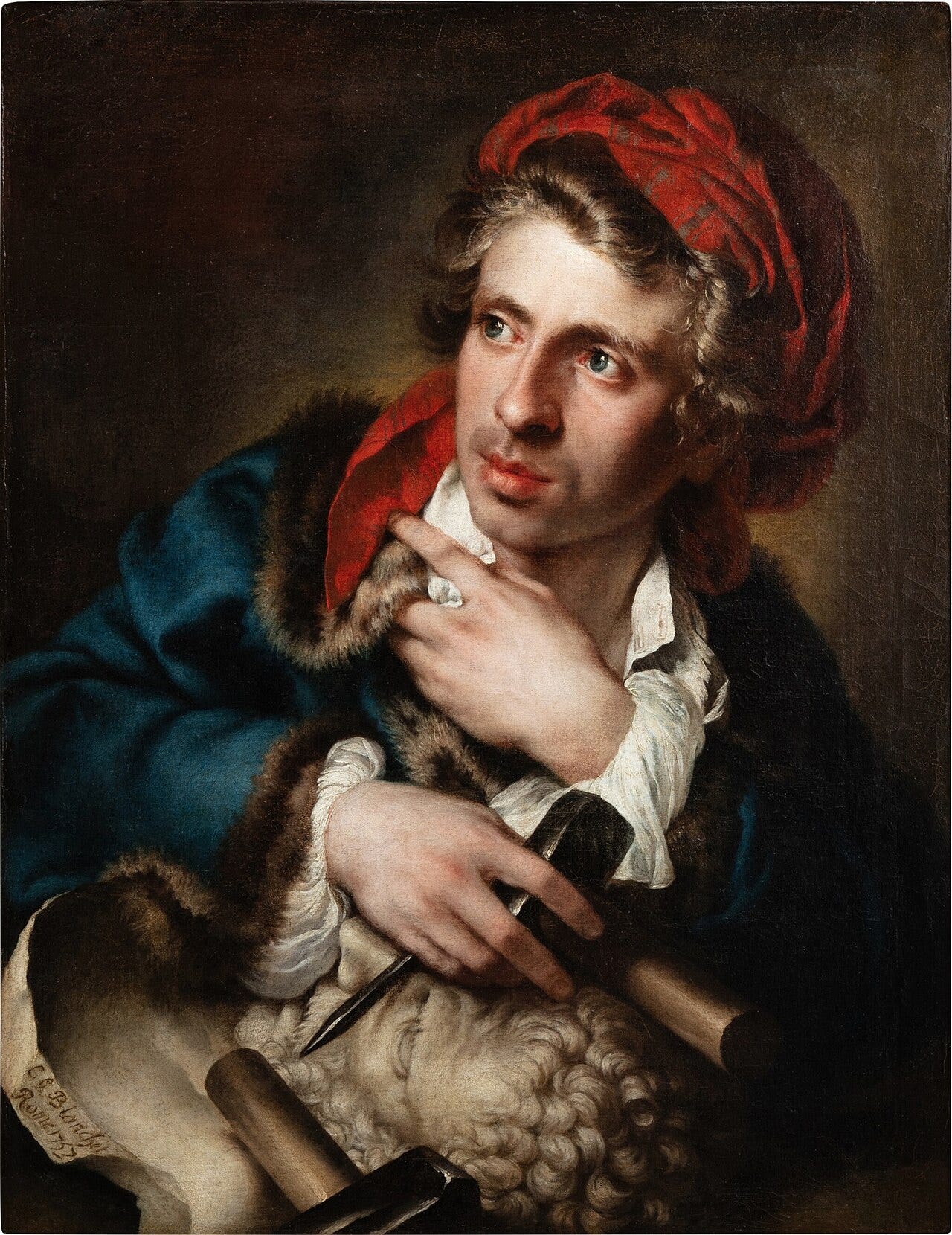
For Wilton, Pitt was a familiar subject. In 1769, Benjamin Franklin presented Harvard College with a marble bust of Pitt, which was probably a copy of a Wilton sculpture completed 10 years prior. The gift inspired the College to proclaim the statesman as the champion of American liberty.
After receiving the commissions from South Carolina and New York, Wilton and his apprentices spent the next few years carving similar statues of Pitt out of fine Italian marble. They transformed the English orator into the image of a Roman senator, in the visage of Cicero. Pitt wears a toga and sandals. He appears as if in motion, rising from his seat with a copy of Magna Carter in his (missing) right hand, while gesturing with his (missing) left hand to declaim upon the rights sacred to all British subjects.
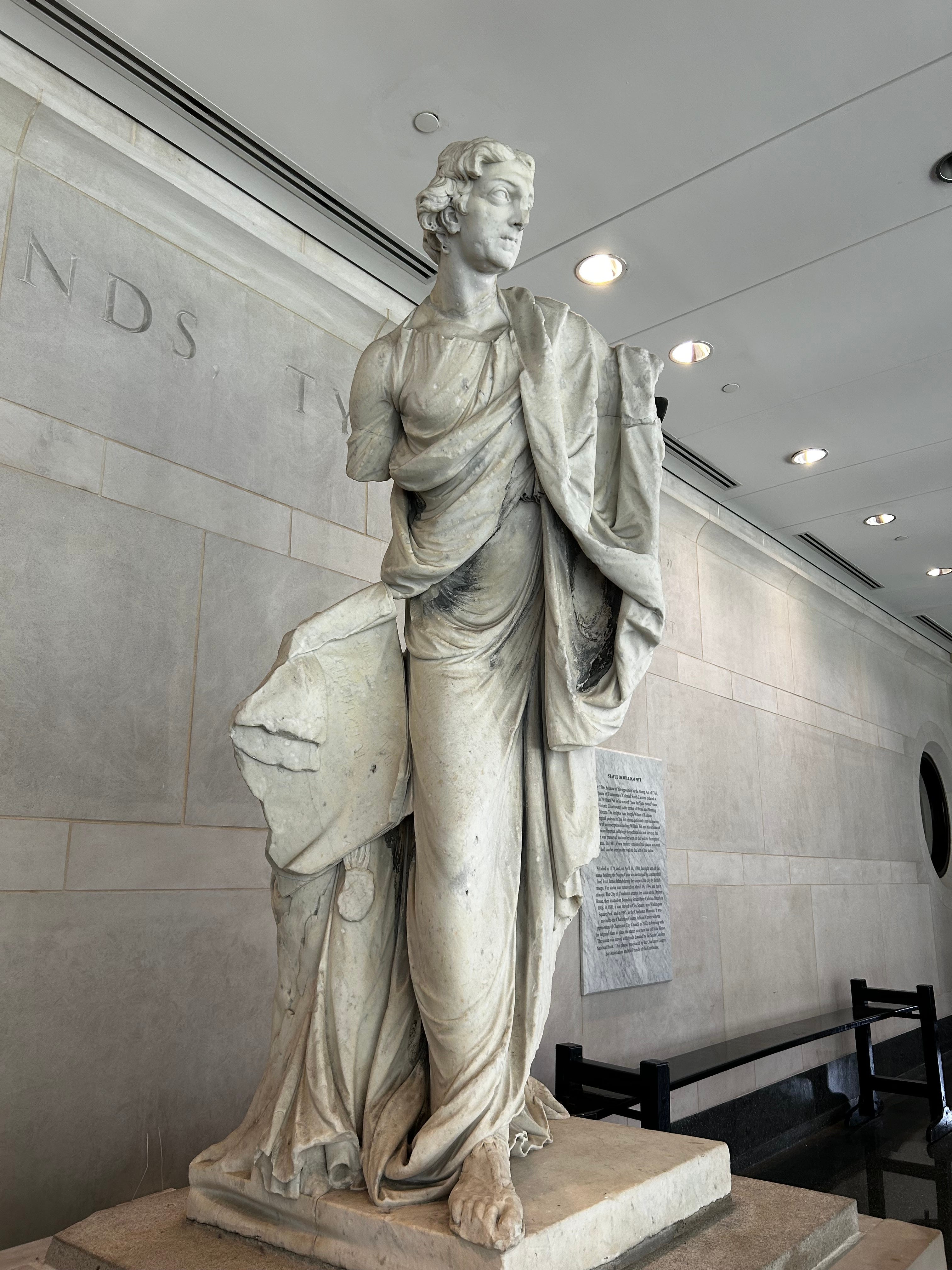
Although both statues of Pitt survive, South Carolina’s is larger and the most complete. New York’s variant suffered decapitation and partial dismemberment during and in the years after the British occupation of Lower Manhattan beginning in late summer 1776. Its remains are now in New York Historical.
South Carolina’s monument to Pitt arrived in Charleston aboard a packet ship in mid-May 1770. According to the local newspaper, it landed at Charles Elliott’s wharf at about nine in the morning on Tuesday, the 28th, “amidst a vast Concourse of the Inhabitants, many of them of the first Rank and Consequence.” It was moved to the Armory, where it was kept while its foundation and pedestal were constructed at the corner of Broad and Meeting Streets.
By then, the real Pitt was no longer “the Great Commoner,” as he was sometimes known, but now Lord Chatham, and a member of the House of Lords.
In the years since Pitt spoke on the floor of the Commons in favor of the Stamp Act’s repeal, Parliament made good on its claimed right in the Declaratory Act by imposing a new round of taxes on paper, paint, lead, glass, and tea known as the Townshend Duties, and undertaking a number of other imperial reforms, much to the colonists’ dismay.
Nevertheless, Charlestonians put on a grand show when they assembled to witness the installation of Pitt’s statue in early July 1770. Ships in the harbor “hoisted their Colours, and a Flag, with the Words PITT AND LIBERTY, and a fine branch of Laurel above it” were affixed to a staff 45-feet high. That number was precisely chosen in honor of John Wilkes, an anti-Scottish polemical English-favorite of American colonists, whose publication of the North Briton No. 45 in 1763 had led to charges of libel and Wilkes’ brief imprisonment in the Tower of London.
From the scaffolding, Peter Manigault, speaker of the colony’s House of Commons, proclaimed the inscription carved into the pedestal:
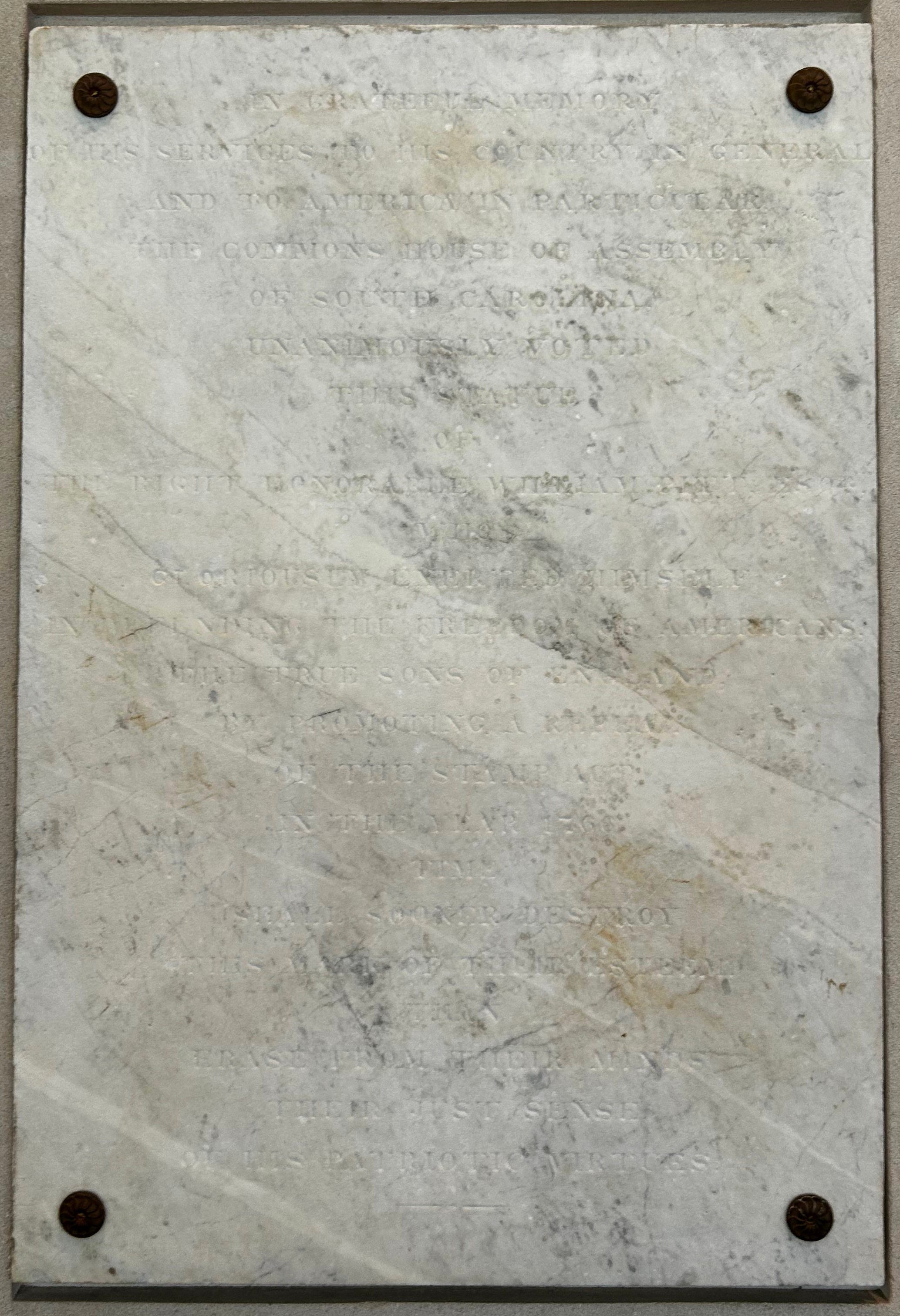
The worn text reads:
In Grateful Memory
Of His Services To His Country In General
And To American In Particular
The Commons House Of Assembly
Of South Carolina
Unanimously Voted
This Statue
Of
The Hon. William Pitt, ESQ.
Who
Gloriously Exerted Himself
By Defending The Freedom OF Americans
The True Sons of England
By Promoting A Repeal
Of The Stamp-Act
In The Year 1766
Time
Will Sooner Destroy
The Mark Of Their Esteem
Than
Erase From Their Minds
Their Just Sense
Of His Patriotic Virtue
When Manigault finished, cannon boomed in celebration, followed by three huzzahs from the crowd. Church bells rang. “Joy sat on every countenance.” Later that day, the town’s elite gathered at Dillon & Gray’s Tavern for a celebratory feast and merriment, capped off with 45 toasts, including one to the king, one to Lord Chatham, and one to “The Men who will part with Life before Liberty.”
The sources do not mention the presence of enslaved people, but there is no doubt they were there. South Carolina’s economy and society was intimately tied to slavery and the transatlantic slave trade. White Charlestonians had more in common with their fellow subjects in the West Indian sugar colonies than they did colonies like New York. Enslaved people would have been present at the ceremony, hearing the grand pronouncements as they attended to their enslavers or labored in other ways. How exactly they interpreted a monument erected to liberty while they were held in actual bondage is difficult to know in the absence of their own voices, but the flight of enslaved people to the king’s standard on the promise of freedom during the Revolutionary War is just one example of how the enslaved gave their own meaning and definition to liberty.
For ten years, Pitt stood his ground on the corner of Broad and Meeting Streets. In that time, the imperial crisis brewing in 1770 gave way to a colonial rebellion in 1775, that soon transformed into a war for American independence in 1776, that in turn led to the British laying siege to Charleston in 1780.
In the meantime, the real Pitt had died. In April 1778, he collapsed in the House of Lords during a debate over whether the king should seek peace with the American rebels. Pitt, to the disappointment of his many American admirers, was firmly against their independence. He never recovered from his stroke and died on May 11th.
Two years after the mortal Pitt’s death, the marble Pitt suffered a flesh wound. During the Siege of Charleston in April 1780, a British cannonball hit the statue, destroying the right arm holding the copy of Magna Carta. Despite the bombardment, the rest of the statue survived the subsequent British occupation of the town as well as Charleston’s recovery by American forces near the end of the war.
The arrival of peace in 1783 raised the question of just what to do with a statue that honored a British statesman in an independent South Carolina. No one seemed to have a good answer. Pitt may have opposed American independence, but in some respects, time hadn’t “erased from [South Carolinians’] minds their just sense of his patriotic virtue.”
Following the war, Pitt’s statue embarked on somewhat of a local odyssey.
In 1791, after a newspaper editorial complained that “no less than four chairs [chaises] had been dashed to pieces against Pitt’s statue” in recent months, the city council ordered its removal “to some other more safe and convenient place.” The deinstallation was finally carried out in 1794. Unfortunately, it toppled over as laborers removed it from its pedestal, severing Pitt’s head from his body (though it was later repaired). The statue was placed in the Arsenal.
The battered Pitt remained in the Arsenal until 1808, when it was installed at the nearby Orphan House. There, Pitt weathered the early years of the republic and survived the devastation of the Civil War before taking up residence in Washington Square in 1881. The part of the pedestal featuring the inscription was purchased by a local judge and installed in his garden.
For more than a century, Pitt remained in Washington Square. He bore witness to the struggle for civil rights and the full realization of the self-evident truths espoused in the declaration he had opposed. He passed through an era of global war fought on scales he would have recognized, with outcomes no less consequential than the victory he had helped to engineer nearly two hundred years earlier. And Pitt was present to celebrate the bicentennial of a nation born as a result of some of the decisions made in the wake of his great triumph.
In 1985, Pitt was once again moved, this time to the Charleston Museum on Meeting Street. Now, it seemed, Pitt would become resigned to history.
But in 2002, the Charleston City Council authorized the statue’s removal to the Charleston County Judicial Center. It did so “in keeping with the original plans to place the statue in or near the old State House.”
That’s where I found Pitt — now missing both arms — on a recent and blazingly hot South Carolina day.
Two-hundred-fifty-six years after South Carolinians first erected Pitt’s monument on a foundation not far from where he now stands, the man British Americans once revered for his defense of their rights and liberties now greets defendants, families, judges, attorneys, and court officials as they pass through the Judicial Center’s lobby in the pursuit of justice. The inscription that graced his pedestal is mounted on the wall just off to the statue’s side.
And behind Pitt — “that great Assertor of American Liberties” — is a quote from John Locke carved deep into the granite wall that Pitt would have well recognized.
“Where Law Ends, Tyranny Begins.”
Further reading and listening:
Jim Ambuske, “Episode 10: The Stamp,” Worlds Turned Upside Down, podcast, 13 September 2024 (R2 Studios: George Mason University).
Fred Anderson, Crucible of War: The Seven Years’ War and the Fate of Empire in British North America, 1754-1766 (Alfred A. Knopf, 2000).
Zara Anishanslin and Joanna Cohen, “MONUMENT,” Thing 4 Things, podcast, 19 June 2025.
Wendy Bellion, Iconoclasm in New York: Revolution to Reenactment (Penn State University Press, 2019).
Patrick Griffin, The Townshend Moment: The Making of Empire and Revolution in the Eighteenth Century (Yale University Press, 2017).
Robert G. Parkinson, Tyrants and Rogues: Understanding the Declaration of Independence (W.W. Norton & Company, 2026).
D. E. Huger Smith, “Wilton’s Statue of Pitt,” The South Carolina Historical and Genealogical Magazine (January, 1914).